
Properties and Uses of 420 Mod Stainless Steel
- Details
- Written by: David Hannah
Here's my brief conversation about 420 MOD (UNS 42025, AMS 5925, ASTM F899) with ChatGPT:
Question: What are some Properties and uses of 420 Modified Stainless Steel?
Chat GPT: 420 Modified Stainless Steel is a type of martensitic stainless steel that has been modified with the addition of molybdenum and vanadium. This modification enhances the material's corrosion resistance, toughness, and strength. Here are some properties and uses of 420 Modified Stainless Steel:
Properties:
- Corrosion resistance: 420 Modified Stainless Steel has good resistance to corrosion in mild environments.
- Hardness: The material has high hardness and wear resistance.
- Toughness: The addition of molybdenum and vanadium improves the toughness of the material, making it less brittle.
- Machinability: 420 Modified Stainless Steel is easily machinable due to its low carbon content.
- Heat resistance: It has moderate resistance to heat, but not suitable for high-temperature applications.
Uses:
- Medical instruments and equipment: The material's corrosion resistance, hardness, and machinability make it suitable for use in surgical instruments and medical equipment.
- Industrial equipment: The material's hardness and wear resistance make it suitable for use in industrial equipment such as pumps, valves, and gears.
- Cutlery: 420 Modified Stainless Steel is used to make high-quality knives and cutlery due to its corrosion resistance and hardness.
- Aerospace and defense: It's used in the manufacture of aircraft components, firearms, and other military equipment.
Overall, 420 Modified Stainless Steel is a versatile material that offers a good combination of corrosion resistance, toughness, and strength, making it a popular choice in various industries.
Steel and Aluminum Tariffs 2025
- Details
- Written by: David Hannah
Steel and Aluminum Tariffs 2025
The current administration has issued a new executive order expanding the existing tariffs on imported steel and aluminum. As of now, these go into effect March 12, 2025.
The United States' specialty stainless steel industry has long been supplied by European mills. Our mills currently don't have the capacity or ability to produce the highly processed specialty alloys needed to supply our medical and aerospace industries. This is expected to affect costs within the medical, aerospace, and defense industries.
Key Changes That Affect Specialty Metals:
- Quotas and Exemptions to the existing tariffs are no longer an option.
- Quality, Availability and National Security concerns are no longer considered as valid reasons for exceptions (Proclamation Section 17)
- No new exclusions will be authorized for these tariffs.
How This Might Affect You
- Prices may rise: This has already been seen in the last two weeks, sometimes as much as 30% as mills look to adapt to future market conditions.
- Lead times may be unpredictable: Lead times at American mills capable of producing implant grade stainless steel are already long. They may grow.
- Quotes will be valid for short periods: The material cost you factor into your estimates may not be the cost when you're awarded the job.
- Prices on incoming mill shipments may change drastically at time of shipment.
-
What You Can Do
- If you have active customer orders we strongly recommend placing orders now to lock in current prices and avoid future cost increases.
- Consider blanket orders on available stock. That pricing will not change.
- Contact your local and national representatives to push for exemptions for critical materials. Without quotas and exemptions the cost of the tariffs will no longer be spread over large quantities of product.
- Contact our account representatives directly, or through
This email address is being protected from spambots. You need JavaScript enabled to view it. with any questions you may have.
The Discovery and Uses of Metals
- Details
- Written by: Zoe Bernard
The Discovery and Uses of Metals
What would human civilization look like without metal? The discovery and understanding of different metals and alloys have shaped the way humans lived, fought, and made progress. From the early years of the bronze age to the more recent uses of stainless steel, few things have had as much influence on the world as metal.
Historical Timeline
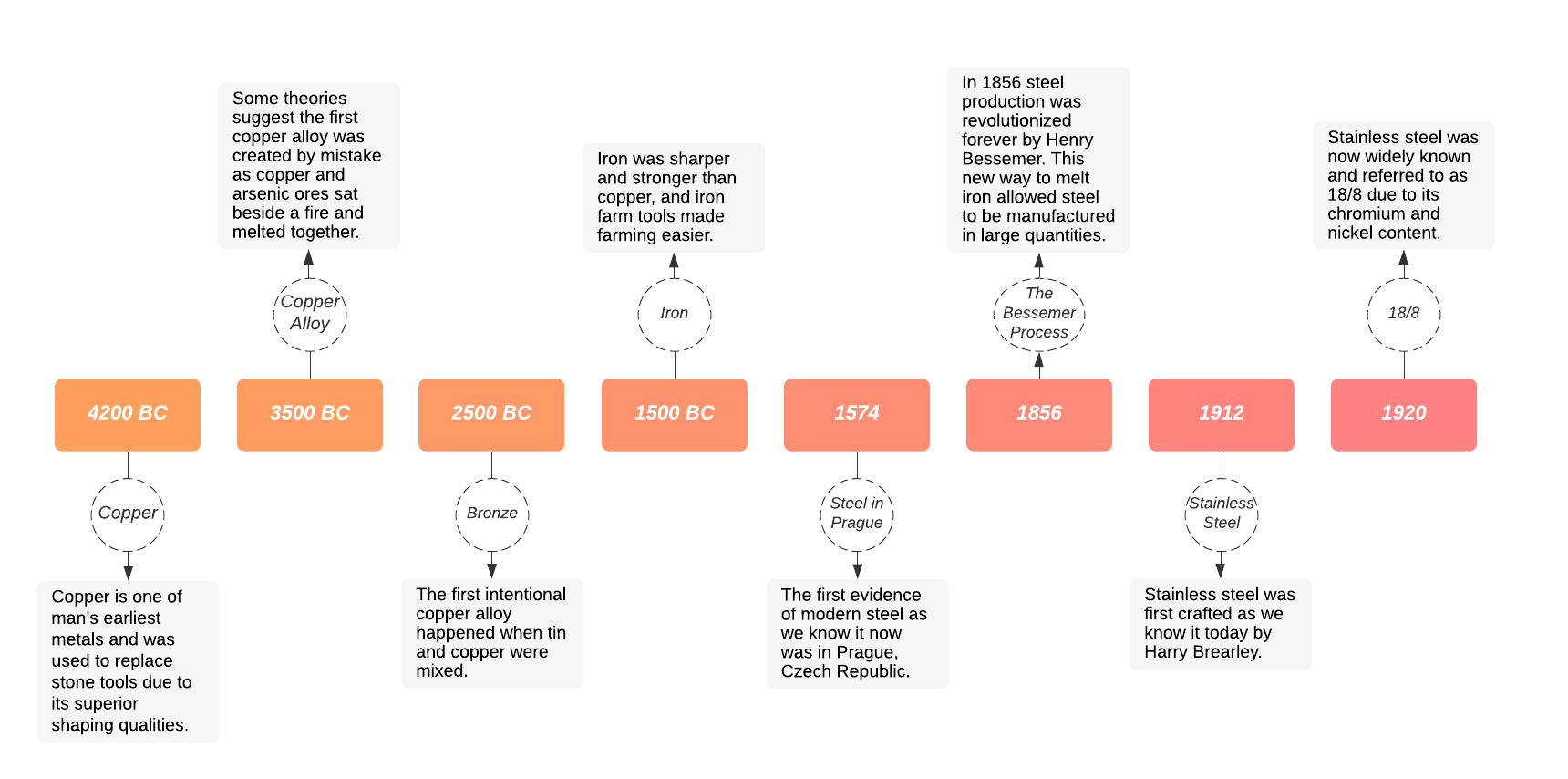
4200 – 2500 BC
Copper - Bronze
Copper is one of man’s earliest metals and was used to replace stone tools due to its supeior shaping qualities. Though copper’s exact origin is uncertain, archaeologists generally credit early Mesopotamians as the first to fully harness copper’s abilities. However, it is believed that this copper was mostly used for decorative purposes, since its relatively soft composition made it less than ideal for most tools.
The next step of progress was bronze, a copper alloy. An alloy is a metal that combines two or more metals or elements to create a new material.
Some theories suggest the first copper alloy was created by mistake somewhere around 3500 BC, as copper and arsenic ores sat beside a fire and melted together. Whether or not that is entirely true, the first intentional copper alloy happened later (2500 BC) when tin and copper were mixed, thus introducing bronze to the world. Bronze was stronger and superior to pure copper. This early combination would not be the last alloy to change the world.
1500 – 300 BC
Iron
Before there was steel, there was iron.
Iron was used for tools and weapons, and was superior to its predecessor, bronze. While bronze had required both copper and tin resources, iron was a single material that could be smelted at high heats. The abundance of iron made it extremely accessible, and those able to craft it immediately implemented it into all facets of life. Iron was sharper and stronger than copper, and iron farm tools made farming easier and tough ground more workable. Iron’s discovery also put weapons, such as swords and spears, into the hands of many for the first time, permanently changing the course of the world.
1574 – 1900
Steel
Steel is an iron alloy formed with a low amount of added carbon, which gives it additional strength. Though steel has been present within civilization for thousands of years, it was often difficult to work with and overall scarce. The first evidence of modern steel as we know it now was in Prague, Czech Republic in 1574, then in England by 1614. As the 17th century continued and the prevalence of steel rose, it became known that the best steel of the time was in Stockholm, Sweden.
In 1856 steel production was revolutionized forever by Henry Bessemer. The Bessemer process was a new way to melt iron. It used molten pig iron and airflow to melt and purify the steel. This process allowed steel to be manufactured in large quantities and for a relatively low price.
The new accessibility of steel, thanks to the Bessemer process, changed the way the world travelled and planned. Steel rails were considerably stronger and held up ten times longer than iron rails. Steel trains could withstand heavier loads, making railroad transportation more efficient. Additionally, steel’s strength made skyscrapers a possibility for the first time, permanently changing the way cities grew and operated.
1912 –
Stainless Steel
Stainless steel was first crafted as we know it today in 1912 by Harry Brearley. Brearley sought to form a corrosion resistant alloy for use in gun barrels. Amidst the process, one material remained rust free in the scrap heap. This martensitic stainless steel would later be known as the 420 grade.
By 1920 stainless steel was widely known and referred to as 18/8 due to its chromium and nickel content. With stainless steel’s growing popularity, its hygienic qualities were revealed. Stainless steel was corrosion resistant and safely used in 1928 to brew and hold beer, making it a prime material in the medical field and in food storage.
In 1931 stainless steel was used for aircraft for the first time. Though lighter materials such as aluminum and titanium are now preferred by the aerospace industry, stainless steel is still utilized for smaller pieces and parts. A few commonly used stainless steel grades in airplane parts are 13-8 MO, 15-5 PH, and 17-4 PH.
Stainless steel is now sorted into four general types with over 150 grades, and is used in millions of parts, machines, and other daily use items.
Understanding DFARS Specialty Metals
- Details
- Written by: Kim Walburg
Understanding DFARS Specialty Metals
Definition
DFARS, or the Defense Federal Acquisition Regulation Supplement, was created as a set of regulations to ensure the security of products procured for the Department of Defense (DoD).
Any supplier conducting work for or fulfilling contracts for the DoD is subject to DFARS compliance. DFARS itself has multiple subsections with different requirements based on what section is specified in the purchase order or customer-supplier quality agreements.
Common Clauses
'DFARS' itself is commonly used as a single qualification. However, the term 'DFARS' is really a starting point to further requirements and is not necessarily applicable on its own. To fully comply with DFARS, more specific language - such as the section/clause of DFARS - must be given to the supplier.
Some of the most common subsections of DFARS literature related to specialty metals are 252.225-7001, 252.225-7008, and 252.225-7009. These three sections are what most companies mean when saying 'DFARS.' But their content varies greatly.
DFARS 252.225-7001 – Buy American and Balance of Payments Program
Requires certain products purchased under U.S. Government contracts to be sourced from approved domestic or qualifying-country sources. This can be seen as the "master" requirement, which is refined in the other two clauses specifically about specialty metals.
DFARS 252.225-7008 – Restriction on Acquisition of Specialty Metals
Requires specialty metals delivered under the contract to be melted or produced in the United States or its outlying areas.
DFARS 252.225-7009 – Restriction on Acquisition of Certain Articles Containing Specialty Metals
Provides exceptions and flow-down requirements for specialty metals and permits material from the list of qualifying countries for most orders. (This is the most common requirement and is nearest to the removed clause DFARS 252.225-7014. This clause causes confusion because it is not as clear as 252.225-7014 was, and it is not always known to have been removed.)
Example
A supplier is sourcing product from Denmark. Denmark is a DFARS qualifying country, but it is not compliant with DFARS 252.225-7008. So, if the end user simply says DFARS but really means the product to be American made, this must be specified in the PO as a clause.
In other words, the PO simply saying "DFARS" for this situation would not fulfill end user requirements, as most DoD contracts pass through AS9100 certified companies – flow down is required through the entire supply chain.
For Purchasing Agents
Examples of customer language we commonly see:
- "Requirement for Domestic Metal Applies per DFARS 252.225-7009" – This is an example of correct use of DFARS.
- "Must be Domestic/DFARS" – While slightly more detailed than only saying "DFARS," "Domestic" can refer to multiple different DFARS clauses.
- "Must be DFARS compliant", or simply "DFARS" – Widely different requirements fall under DFARS, and this can cause confusion for both supplier and customer. It leaves the supplier to assume unnecessary risk.
It is good practice for the customer to be as specific as possible regarding DFARS clauses when submitting a PO, and for a purchasing agent to work with the customer to ensure all requirements are indicated when placing an order.
When possible and if known, state a product's country of origin on all paperwork and ensure it aligns with the DFARS clause(s) required.
Furthermore, indicate if the use of the term "DFARS" is an either/or situation: meaning a country of origin on the DFARS qualifying countries list, or if the product must be domestic.
Need Help Navigating DFARS?
Navigating DFARS can be challenging, and we are here to help. We acknowledge a responsibility to help inform customers regarding criteria in which we have a wealth of knowledge.
Contact M. Vincent and Associates for assistance with DFARS.
M. Vincent and Associates supplies aerospace, defense, and specialty metal products with full material traceability, DFARS sourcing support, and AS9120-certified quality management.
Page 3 of 3